
Summary
For millions of Hindus, the Vedas are the eternal voice of Dharma, whose verses are the ground on which the modern Hindu society stands. Vedas are sources that guide human life toward righteousness (satya), harmony (rita), and spiritual liberation (moksha). Their wisdom continues to inspire seekers, shaping religious practices, as well as the very essence of Hindu thought, philosophy, and way of life. This blog explores the influence of the Vedas on Hindu philosophy, society, science, and rituals, offering a glimpse into their relevance and sacred significance.
What are the Vedas, and why are they important in Hinduism?
The Vedas are the oldest and most sacred scriptures of Hinduism, revered as the foundation of spiritual and philosophical thought in Indian tradition. The word Veda is derived from the Sanskrit root vid, meaning “knowledge” or “wisdom,” signifying their role as a divine revelation of ultimate truth.
These texts are a vast repository of cosmic knowledge, encompassing hymns, rituals, philosophy, and metaphysical insights that have shaped Hindu culture for millennia. Unlike historical texts with a single author or fixed date of composition, the Vedas are believed to be apauruṣeya, not of human origin, and were transmitted orally for generations before being written down.
What do the Vedas teach us?
They teach principles of moral duty, cosmic order (Rita), and paths to spiritual freedom (Moksha).
Why are the Vedas important today?
They shape rituals, festivals, yoga, meditation, and ethical values, continuing to inspire millions worldwide.
Significance of the four Vedas in Hinduism
These sacred scriptures are said to have been introduced to India by the Aryans. Being truly sacred, Hindus believe that god himself imparted the Vedas to scholars. As such, Hindus think of the Vedas as being apauruseya, or in other words, “not of man but supernatural”. The scholars then passed on the holy words of god.
For many centuries, the sacred scriptures were entirely passed on and spread to Hindu believers by word of mouth. Complex mnemonic techniques, such as the Vedic chant, greatly helped in the oral transmission of the sacred scriptures, passing the Vedas on from one generation to the next, since the second millennium BCE.
To this day, so many years later, many parts of the Vedas are still recited with particular intonations, specific syllabic accents, cadence, and rhythm that have been passed down orally since the early days of the Vedas. The sacred scriptures themselves that are contained in the Vedas are a collection of poems or hymns that were produced in archaic Sanskrit.
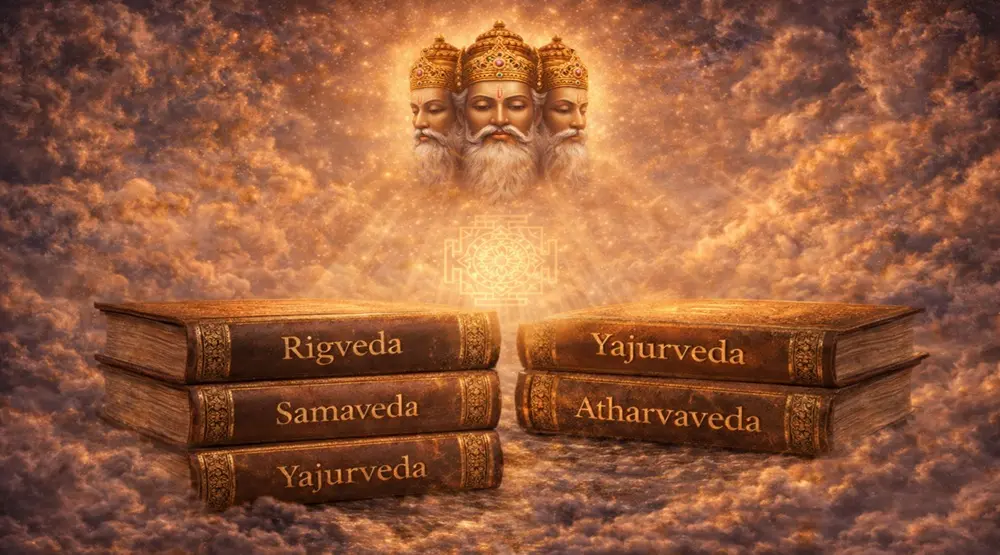
These were composed by individuals who were living in the northwest of India and who believed and worshipped many different gods. The Vedas are divided into four: Rigveda, Yajurveda, Samaveda, and Atharvaveda.